Object Record
Images
Metadata
Object Name |
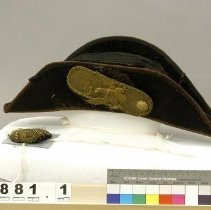
Hat, Cocked |
Catalog Number |
1881.1abc |
Creator |
Nesterov, I. |
Date |
ca. 1865 |
Material(s) |
Leather/Fur/Cotton/Cardboard |
Dimensions |
H-5.5 W-18 inches |
Description |
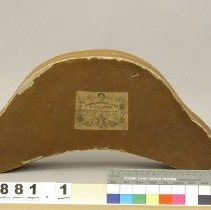
(A) This leather bi-corne chapeau-bras is covered with brown cotton base with black beaver fur that was combed and pulled through the cotton material. The black ribbons hold the two sides of the hat together. It has a red leather sweat band, pink silk lining and a black hat band. There is a gilt eagle on a woven brass wire oval with brass eagle button. The brass wire bullion cockage has painted blue curled wire on the underside. The top of the cockade is lined with brown cotton and brown thread secures th top edges. (B) The bottom section of the hat box is cardboard covered in brown paper with a orange-red paper edging (C) The top of the box is cardboard covered brown paper with orange-red paper edging. There is a label in Russian on the top that depicts military items such as armor and hats. Across the label in pencil C.M.Clay. |
Notes |
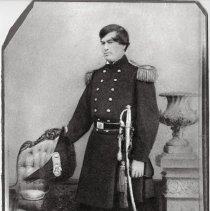
Worn by Cassius M. Clay (1810-1903) as part of his diplomatic uniform serving as the Minister of Russia. Clay's donation of papers and artifacts was one of the first and most important gifts received by the KHS upon its reorganization in the late 1870s. Born in a slaveholding household in Madison County, Kentucky, Clay first heard abolitionist William Lloyd Garrison speak while attending Yale. Clay then vowed to fight against chattel slavery, stating Garrison's words were "as water is to a thirsty wayfarer." Frustrated at not being able to publish his anti-slavery views, Clay founded his own newspaper, The True American (1845-1847), in Lexington. The newspaper caused so much controversy Clay had to defend the printing office with cannon and gunpowder. Publishing an article so "incendiary," a court injunction was issued against his printing and protesters broke in to dismantle the press causing Clay to move his operation to Cincinnati. Clay traveled around for various speaking engagements, meeting Abraham Lincoln at one. The two became good friends, and Clay campaigned for Lincoln in the 1860 election. Lincoln appointed Clay as Minister to Russia (1861-1869). In 1862, he publicly refused to accept a commission as a major general from Lincoln until Lincoln signed an emancipation proclamation. Clay had witnessed the Russian Czar's "Emancipation Reform of 1861" which freed 23 million serfs and gave them citizens' rights. Lincoln sent Clay to Kentucky to assess the reaction to possible emancipation there and in other border states. Upon Clay's return to Washington D.C., Lincoln issued the proclamation, and Clay resigned his commission and returned to Russia in 1863. Russia sent warships to American waters to protect the Union in the case of England or France joining to support the Confederacy. |
Collection |
Cassius M. Clay Collection |
People |
Nesterov, I. Clay, Cassius Marcellus, 1810-1903 |
Subjects |
Diplomacy Hats Diplomats |
Physical Holder |
Kentucky Historical Society - KHS |