Object Record
Images
Additional Images [8]
Metadata
Object Name |
Medal |
Catalog Number |
2018.9.1 |
Date |
ca. 1918 |
Material(s) |
Wood/Cotton/Silk/Brass/Bronze/Metal/Glass |
Dimensions |
H-21 W-17 D-2.25 inches |
Description |
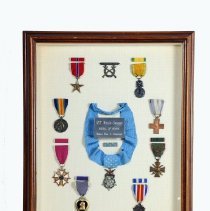
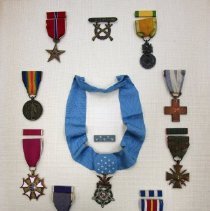
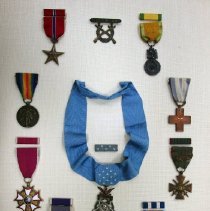
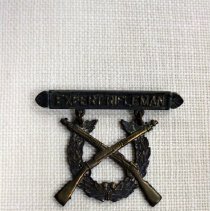
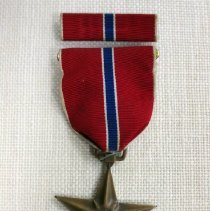
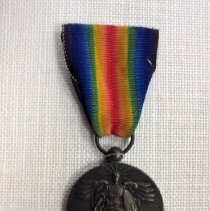
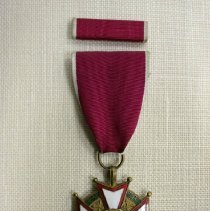
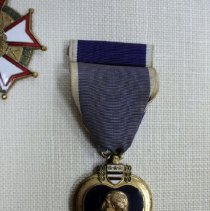
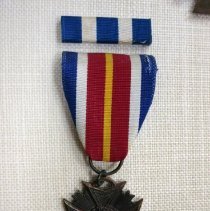
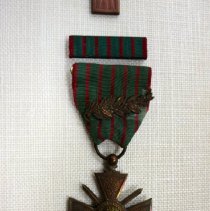
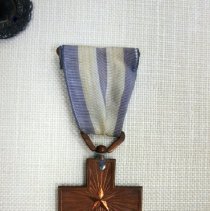
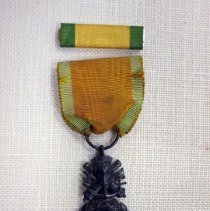
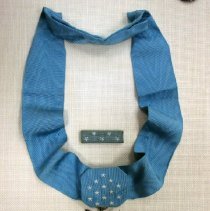
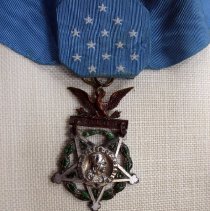
This is a shadow box containing medals, ribbons, and a qualification badge presented to Sergeant Willie Sandlin of Buckhorn, KY. It has a wooden frame. The interior is lined with an off-white fabric. In the center there is a silver-colored plaque that is engraved "SGT Willie Sandlin Medal of Honor World War I - Kentucky." The medals, ribbons, and badge are sewn to the fabric lining. The medals include the following: 1. The Congressional Medal of Honor and ribbon bar. The Medal of Honor is a plated five-pointed star over a green enameled olive wreath suspended from copper a United States eagle. The medal is attached to a blue silk octagon decorated with thirteen white stars. This example has a blue silk ribbon designed to hang around the wearer's neck. The ribbon bar for the Medal of Honor is also included. The ribbon bar has blue silk twill ribbon with five white stars. This example has a safety clasp on the back. 2. The Legion of Merit Medal and ribbon bar. The medal has a pink silk twill ribbon with narrow white trim. The medal hangs from ring at the bottom of the ribbon. The Legion of Merit ribbon bar has a pink silk twill ribbon with narrow white trim crimped into a bar with a brass safety clasp. 3. The Bronze Star Medal and ribbon bar. The medal is a five-pointed star with a raised star in the center on the obverse. There is a motto on the reverse. The medal is suspended from a red silk twill ribbon with white and blue pinstripes in the middle. The ribbon bar has a red silk twill ribbon with narrow white trimmed blue stripe down middle that is crimped into brass safety clasp. 4. The Purple Heart Medal. This medal has a purple silk twill ribbon with white trim. The medal is suspended from the ribbon by a ring. It is a heart-shaped gold and purple medal with a relief of George Washington on the obverse. The ribbon bar has a purple silk twill ribbon with white trim crimped into brass safety clasp. 5. The World War I Victory medal. This medal has a polychromatic purple, blue, green, yellow, orange, and red ribbed silk ribbon. The ribbon is attached to the medallion with a brass ring at the bottom. The medallion medal featuring the goddess "Victory" on the obverse with sword and shield. 6. The Expert Rifleman Badge. This badge has a clasp bar with swivel pin and catch. The medal features a wreath with crossed rifles suspended from the clasp bar. 7. The French "Medaille Militaire" (Military Medal). This medal has a green and gold striped silk twill ribbon crimped into brass bar with a safety pin clasp. It features a two part lacquered brass medal suspended from a ring through the looped ribbon. The top part of the medal is a breastplate over crossed cannon. The bottom has a wreath around a woman's face in profile. The French Military Medal ribbon bar is mounted above the medal. It features a yellow silk twill ribbon with green trim crimped into brass safety clasp. 8. The Italian "Merito Di Guerra" (War Merit Cross). This medal has a blue and white striped silk twill ribbon crimped into brass bar with horizontal pin mount (note that the blue is faded to purple). The medal features a copper cross suspended from the looped ribbon. There is a star in the center of obverse of the cross and a motto on the reverse. The Merito Di Guerra medal ribbon bar is also included, but it is mounted over the VFW medal. The ribbon bar has a blue and white striped silk twill ribbon crimped into brass safety clasp. 9. The French Croix De Guerre (War Cross) medal. This medal has a green and red striped silk ribbon crimped into a brass bar with a horizontal pin. It features a bronze Maltese cross with crossed swords suspended from a ring. There is a woman's face in profile in center of the obverse. This example has an olive (or laurel) branch pinned to middle of ribbon. The Croix De Guerre ribbon bar is mounted above the medal. The ribbon bar has a green and red striped silk twill ribbon crimped into brass safety clasp. 10. The Veterans of Foreign War (VFW) membership medal. This medal has a red, white, and blue silk ribbon with gold pinstripe in the middle crimped into brass bar with horizontal pin. The medallion is a copper Maltese cross with rays of light. This medal features the seal of the VFW on the obverse. |
Notes |
These medals were awarded to Sgt. Willie Sandlin, a soldier in the United States Army who received the Medal of Honor for his actions during World War I. Although his military record does not include the award of a Purple Heart, there was considerable controversy about the Veteran's Administration's reluctance to admit responsibility for his gas-damaged lungs. It is likely that his supporters found a way to have the medal awarded at a later date. Born in eastern Kentucky in 1891, Willie Sandlin rose to national prominence for his military exploits in World War I. Upon returning home, he used his celebrity to raise awareness of the costs of adult illiteracy. His 1949 death was attributed to the effects of injuries sustained during his service. Sandlin earned his Congressional Medal of Honor on a day that seems ripped from an action movie rather than real life. Serving as a Sergeant in Company A, 132nd Infantry, Prairie Division, at Bois de Forges, France, on September 26, 1918, Sandlin was determined to advance and capture the objective laid out in the day's orders. Unfortunately, for Sandlin and his troops, they found themselves pinned down by two carefully placed machine gun nests as soon as they began their advance. Yet, Sandlin perceived a slight gap in the coverage arcs created by the machine guns and made a daring dash between them. He was just out of the range of the nests, but under fire from both, as he lobbed hand grenades into one entrenchment. He followed quickly behind the explosions and used his bayonet to subdue those German troops unharmed by the grenades. Sandlin's single-handed capture of one machine gun nest allowed the American troops to outflank the other and advance on toward their objective. Unsatisfied with the eight Germans he put out of the fight in this remarkable episode, Sandlin repeated the feat twice more that day, each time advancing alone with grenades and his bayonet to clear the entrenched enemies from the Americans' path. Despite taking injury in these actions, Sandlin continued to fight through the rest of the war. He participated the broader Battle of Argonne Forest where he experienced the horror of poison gas. One of the most chilling innovations in the technology of war that came out of World War I, poison gas could not be neutralized by a brave charge like Sandlin made at the machine gun nests. Upon returning home after the Armistice, Sandlin bought a farm and settled back in eastern Kentucky. He also took up work against adult illiteracy. He traveled with Cora Wilson Stewart to promote "Midnight Schools" where adults took night classes. He crafted his appeal through his military experiences, emphasizing the difficulties that he had gaining an officers commission because of his early struggles with illiteracy. In 1949, Sandlin died from continuing lung complications that dated back to his exposure to poison gas on the battlefields of France. The lingering illness and eventual death of this brave Kentucky soldier illustrates the changing face of warfare ushered in by World War I. Sandlin's courage proved equal to the challenge of entrenched machine guns, but eventually succumbed to the impersonal weapon of floating chemicals. |
Collection |
Willie Sandlin Collection |
Event |
World War I |
People |
Sandlin, Willie, 1890-1949 |
Subjects |
Awards Awards of merit Medals Military decorations Military uniforms |
Search Terms |
Breathitt County (Ky.) Hyden (Ky.) Medal of Honor Recipients World War, 1914-1918 |
Physical Holder |
Kentucky Historical Society - KHS |