Object Record
Images
Metadata
Object Name |
Dress, Wedding |
Catalog Number |
1954.30 |
Date |
07-03-1873 |
Material(s) |
Silk; cotton |
Dimensions |
H-53 W-45 inches |
Description |
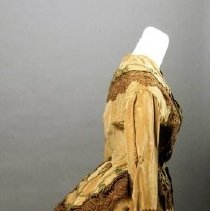
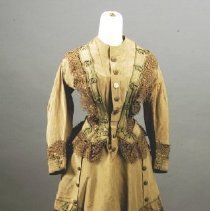
The dress is made of tan colored heavy silk. There are three pieces, the bodice(a), skirt(b) and overskirt(c) and is designed to accommodate a bustle. The bodice (a) is long sleeved with a center-front opening. The small round neckline has no collar. The shoulders are sloped and have dropped sleeves. The seam attaching the sleeves to the torso is finished with green silk piping. The torso is constructed from eight panels, four in front and four in back. The bottom is finished with a sharp point at the front and a long back that comes to a point and is split in the middle up to the low waist, much like a man's tail coat. The front center panels meet at the front closure, which has 13 hook-and-eyes on the inside and false buttons on the outside. The buttons are covered in green silk and have a geometric design in the center. There were eight on the right side and two on the left side at the bottom. One of the eight is missing and one is damaged (though it looks to be a replacement).A ribbon made of a strip of the silk material with olive green cotton silk edging is applied so that every 3 1/4 inches it is folded in to create a six-sided polygon (study of the skirt shows that the green silk is fabric, not tape in a corduroy weave). The trim is attached around the back of the neck, down the front of the bodice on either side of the buttons, along the bottom hem to the back and along the split on the "tails" in the back. A three inch wide crocheted cotton trim has been applied on the outer edge of the ribbon. The crocheted trim has a pattern of a large tear drop shape with an attached six petal flower in the center. Each of this is connected to the other with a pattern of a flower and two squares. The sleeve cuffs are finished similarly. The interior is lined with white polished cotton. The lining forms a small interior pocket in both "tails," similar to men's frock coats of the era. Internal boneing is located in the front under the areas covered by ribbon from waist to breast. There is also boneing in the seams at the most furthest from center. The one on the wearer's right is missing. The skirt (b) is constructed of seven panels with a center panel at front and the last two meeting at the rear seam and create a split opening. The narrow waistband is made of white polished cotton. Presumably the waistband was held closed with a single button, but it is missing. The skirt is attached with a wide box pleat at center front and eight pleats on both sides of it (total 17). A pocket has been built in on the right side in the seam. The hem of the skirt is finished with a simple seam in the interior lining of white polished cotton. Over the bottom of the skirt is a 12 1/2 inch ruffle except for the front 26 inches. In this area there are two layers of 5 1/2 inch ruffle. The short ruffles have 2 1/2 inch wide box pleats that alternate tan silk with a hem of green and a green silk in a corduroy weave with a hem in tan. The lower of the short ruffles is finished at the top with the same ribbon of tan silk with green silk edging and application found on the bodice. The upper short ruffle is applied in a downward curve. It has only the top of each box pleat turned down and is finished with a button. Under this ruffle is a line of the crocheted trim. On the left side of this ruffle is a bow, one loop green and the other tan. There is a third loop in the tan silk beneath this. The right side had the same design, but the bow is now missing, leaving only the tan loop. The long ruffle has a pattern of alternating colored pleating, first a green box pleat and then a tan double box pleat with two buttons applied vertically. There are five green and four tan (one green located center back). The buttons are missing on all but the tan box pleat closest to the wearer's left side. The skirt is completely lined with a white polished cotton material. It is sewn into the seams and reveals the green thread used in constructing the skirt. On both sides on the interior near the front, an 18 1/2 inch long piece of cotton tape has been sewn on the skirt (these appear to have been attached to the bustle or tied together to keep the front of the skirt flat). The overskirt (c) is constructed of three panels in the front and five panels in the back. The seams of the center panel in the front are finished with an inward pleat and decorated with four buttons (same type as on bodice) each, though the top one is missing from both sides. On the sides, over the seam between back and front, is a wide box pleat, 4 1/4 inches wide. They are also decorated with three buttons. The center back panel has a ten inch long split opening with single button closure on the narrow waistband. The two panels on each side of the center back panel is one narrow panel closest to the center and one wide panel closest to the side seam. The wide panel has four horizontal pleats facing down which allows the overskirt to balloon out over the bustle. The hem of the overskirt is finished with the ribbon and crocheted trim mentioned above. Note that there are several places on this dress that repairs in the form of a gauze backing and random stitches for reinforcement. |
Notes |
Helen Kinnaird Herndon lived in Lancaster, Garrard County, Ky. She was born approximately in 1850 in Ohio. Her husband, William Herndon, was a surveyor. They married on July 3, 1873 in Garrard County. As of 1880, they had three sons, Horace, William and Benjamin. |
Collection |
Ann Zimmerman Collection |
People |
Herndon, Helen Kinnaird Herndon, William |
Subjects |
Wedding clothing & dress Wedding costume Weddings Bridal gowns Brides Dress Dresses Women |
Search Terms |
Lancaster (Ky.) Garrard County (Ky.) Ohio Wedding Wedding dress Women Women's clothing |
Physical Holder |
Kentucky Historical Society - KHS |